 Soonqian
Vertical Form Fill Seal Packaging Machines: Real Cost
The true life cycle cost of a vertical forming, filling and sealing machine (VFFS) is actually much higher than the number on the original purchase order. Many purchasing executives tend to focus their eyes on the price of the equipment in the early stage, but knowledgeable production engineers know that the money spent by the machine in this life is all hidden in the daily operation of the workshop-endless waste film, downtime brought by changing lines, and special spare parts monopolized by manufacturers.
If you want to find out the bottom of this equipment thoroughly, you must jump out of the manufacturer’s quotation sheet and calculate 1 the workshop’s operating account. Next, we’ll break down the really killing spending categories in the equipment budget.
Summary Table: Base Price vs. Lifetime TCO for VFFS Models
| VFFS Model Category | Base Price (Initial CAPEX) | Maintenance & Labor Costs | Material Waste & Efficiency | Expected Lifespan | Lifetime TCO Profile |
| Entry-Level (Pneumatic/Basic) | Low ($15k – $40k) | High. Requires frequent manual adjustments and skilled mechanical intervention. | Highest. High film waste during setup; lower OEE (60-70%). | 3 – 7 Years | Top-Heavy. Low entry cost but high operational drain over time. |
| Mid-Range (Semi-Servo / Standard) | Moderate ($50k – $120k) | Moderate. Balanced maintenance; simplified parts replacement and intuitive HMI. | Improved. Servo-driven precision reduces film/product waste (OEE 75-85%). | 8 – 12 Years | Balanced. Best ROI for medium-volume production environments. |
| High-Speed (Full-Servo / Continuous Motion) | High ($150k – $350k+) | Low (Per Unit). Advanced diagnostics, predictive maintenance, and minimal labor. | Optimized. Precision tension control; minimal scrap; maximum OEE (>90%). | 15 – 25 Years | Bottom-Heavy. High upfront cost offset by extreme volume efficiency and longevity. |
Calculate the accounts outside the “price tag”.
The procurement of industrial packaging equipment requires a financial framework that is hard on the details. The “4D-TCO (four-dimensional total cost of ownership) matrix” cuts the cost of the machine into four segments: procurement, operations, consumables and downtime. Using this model can largely avoid the embarrassment of a few years before the machine runs.
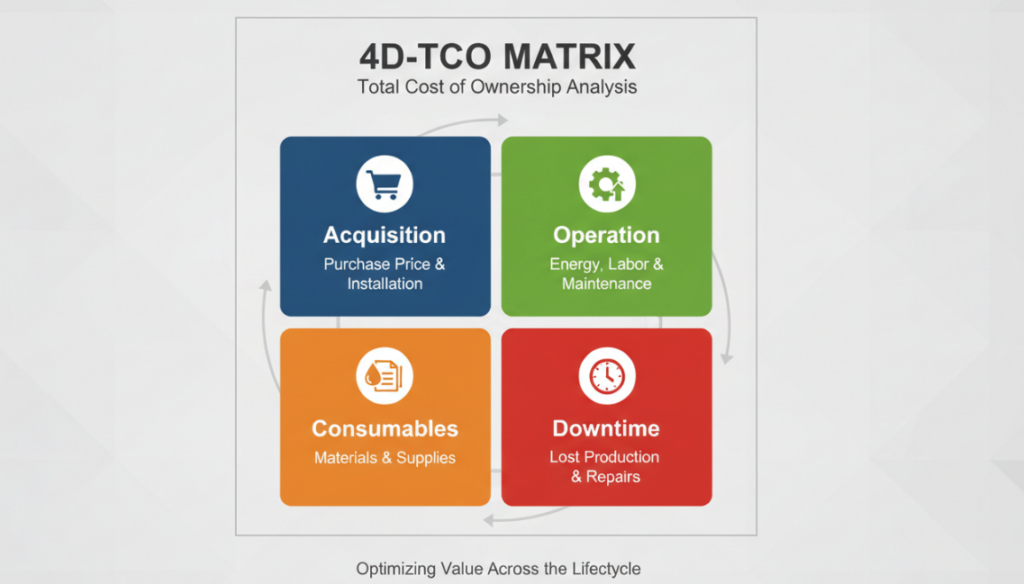
Procurement: Bare Metal And System Integration
The initial equipment expenditure is only the tip of the iceberg of the entire financial investment. Sometimes the basic model looks really cheap, but with the necessary auxiliary integration, the money will soon go up. You have to count the multi-head combination scale, screw metering machine and metal detector. Moreover, if you want to access a third-party feeding device, there is a big hidden cost in the software bridging and synchronization hardware alone.
Operations: Servo And Pneumatic Energy Dark Battle
The driving mode is different, and the energy consumption is very different. The pneumatic-driven vertical packaging machine does have a low threshold in the early stage, but the electricity cost saved by the full servo system over the years is considerable, and it can directly help you avoid the trouble of building expensive industrial compressed air stations. We have done many internal tests, and the results are no suspense-compared with pneumatic equipment, full servo system has an overwhelming advantage on long-term water and electricity bills.
Consumables: Disregarded Waste Film Rate
Film waste belongs to the kind of “invisible killer” that will quietly eat profit margins “. Those ordinary machines that still use the old PLC control system are constantly producing waste film every time they are turned on and changed lines. If you can upgrade to an advanced tension control system, you can push this unnecessary loss to the limit. For those factories that consume a large amount of soft-wrapped film every year, the reduced waste film rate at the end of the year 1 become a real cash profit.
Downtime: The True Cost Of Line Change
The speed of changing lines directly determines the overall efficiency (OEE) of the equipment. Changing the former and sealing pliers on old equipment is often time-consuming and laborious. On the other hand, the current tool-free line change design directly cuts off more than half of the 1 time. You should know that the comprehensive cost of workshop downtime is very expensive. If an old machine has to stop and change lines several times a day, the production capacity lost in a year is definitely an amazing number.
Beware of 3 invisible pits
Some equipment manufacturers deliberately keep their profits very low when selling bare machines in order to lock you up on subsequent expensive consumables contracts. Therefore, before confirming the purchase order, the factory supervisor must first understand the supply chain of replacement parts.
Monopoly-Specific Shaper
Some European and American brands like to engage in some patented locking mechanism on the forming tube. That means you can’t buy third-party alternatives. It was only a routine expense to find a local machine processing factory to order a standard forming tube, but if you replace it with a special one for the original factory, you will have to pay a very high premium.
Closed PLC Program
If the software is locked by the manufacturer, you will have to pay the high entrance fee of the original technician by the hour even if you only make a fine adjustment in the future. Before buying a machine, be sure to ask whether the PLC software is open source or encrypted. If you encounter an encryption machine, you will have to spend money to open remote technical support to get the most basic peripherals such as a coding machine one day.
Customized Sealing Pliers
The heat sealing pliers are vulnerable parts and are changed very frequently. If your machine is equipped with non-standard customized sealing pliers with factory-specific thermal sensors, the annual maintenance budget will probably double. The smartest thing to do is to choose standardized flat sealing pliers, so that you can find a nearby supplier and get flat replacement parts at an extremely cost-effective price.
Actual combat case: the end of snack packaging film loss
Our engineering team did a production line diagnosis for a medium-sized snack manufacturer a while ago. There are several continuous VFFS packaging machines running in their factory at the same time. Customers have a headache because the scrap rate of BOPP film is too high.
The root cause lies in the unstable temperature control of the sealing pliers, which leads to frequent slight air leakage in the bag. So we connected the system with a AI-driven predictive sealing temperature controller. This set of things can dynamically fine-tune the heat of the sealing pliers according to the real-time humidity of the workshop and the running speed of the machine.
The results are as follows:
Waste film rate before transformation: Unacceptably high in daily operation.
After the transformation of the waste film rate: almost dropped to zero.
Annual film savings: directly earned back the 1 large consumables budget.
Return on investment period: All returns within one quarter.
Facts have proved that instead of overturning and buying 1 piles of new machines, sometimes upgrading the sensing technology of existing equipment can make the return much faster.
FAQ
How Much Does A Basic Vertical Packaging Machine Cost?
The threshold for entry-level intermittent equipment produced in Asia is the lowest. The price of mid-range models with well-known brand PLC is in the middle. However, the pursuit of continuous equipment with high-speed operation will inevitably require you to prepare a high budget.
How Long Can VFFS Machines Generally Last?
As long as the maintenance keeps up, the machine can serve for many years. Pure mechanical frames are often extremely resistant to construction, but electronic components, servo motors and PLC, because the technology iteration is too fast, usually before the steel structure aging, because of the elimination of technology needs to do a big change.
How To Estimate The Annual Maintenance Cost Of This Machine?
The factory should allocate an annual preventive maintenance fund in a fixed proportion of the purchase price of the previous equipment. Wear parts such as heating rods, Teflon tape, cutters and film-pulling belts must be replaced periodically, which is the bottom line to ensure that the equipment OEE does not drop the chain.
Can One Machine Handle Bags Of Different Sizes?
Can. The operator only needs to change the corresponding former and readjust the vertical and horizontal sealing parameters to adapt to different bag widths and bag lengths. But one thing is mandatory: for every 1 bag width you intend to produce, you must purchase an additional matching former assembly.
Why Are Continuous Models So Much More Expensive Than Intermittent Ones?
The continuous machine does not stop when drawing film and sealing, and the running speed is absolutely rolling. However, this kind of uninterrupted operation requires extremely complicated software timing to cooperate, and it also needs to use higher-cost rotary sealing pliers, which leads to its overall cost being much higher than that of intermittent models.