 Soonqian
Flow Wrap Packaging Machine: Boost Speed & Cut Costs
Whether your production line can make money or not, a pillow packaging machine plays a decisive role. Through automatic horizontal bag making, it can not only cut off up to 18% of the packaging film waste, but also run steadily at a speed of more than 800 bags per minute in actual production. Eliminating the old manual line and replacing it with a modern pillow packaging machine can really break the bottleneck of production capacity brought by labor. But if you take the wrong path when choosing a model, the ensuing hidden downtime will be devastating. In this article, we will thoroughly break down the underlying data, mechanical structure and real pain points on the production line. To buy a packaging machine, whether to buy a money printing machine or move back to a “mess” that is repaired every day, the answer lies in this.
Calculate Real Operating Costs
In the 5-year life cycle of the packaging machine, the money paid for the machine at first is less than 25% of the total cost. Many factory directors stare at quotations when buying equipment, but turn a blind eye to the frighteningly high operating costs under the water. Take the “Total Cost of Ownership (TCO) Iceberg Model” as an example. Before signing the payment, you must calculate the film loss rate, the labor time required to change production, and the power consumption of the machine.
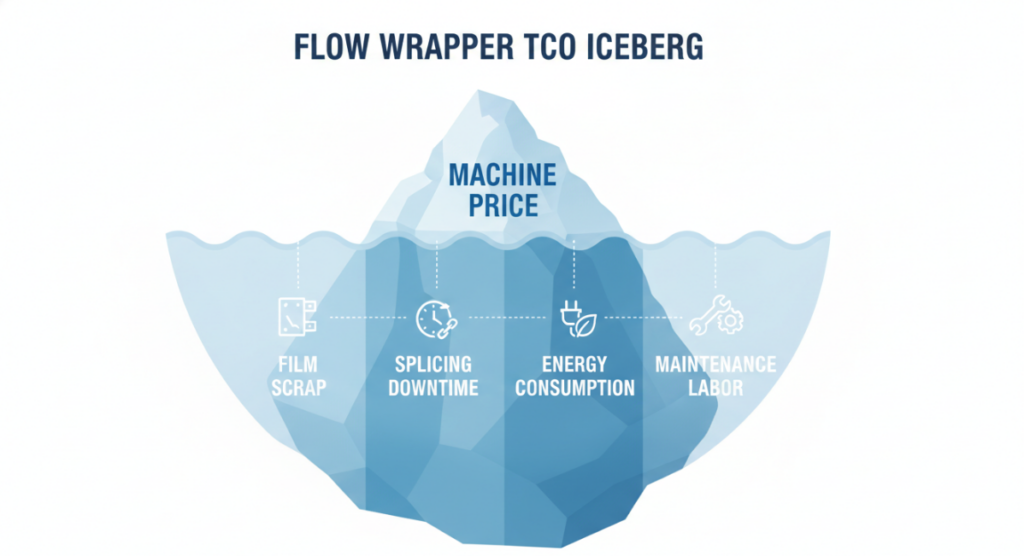
The worst thing that devours profits is the waste of materials. Take the ordinary pillow packaging machine, the tension roller as long as a little bit, each bag of BOPP film will be stretched 2mm. It doesn’t look like much, does it? But with the capacity of 50000 packs per shift, this invisible error can consume hundreds of meters of packaging film every month. With a high-precision servo-driven film feeding system, this stretching deformation can be completely eradicated, which not only ensures the accurate marking of the printed pattern, but also minimizes the leftoves of the film cutting.
If the production is changed and stopped, all the money burned is direct labor. To cut the production line from a 50-gram snack bar to a 150-gram package, the operator has to change the former, adjust the height of the end sealing knife, and reset the edge sealing temperature. If you use an old-fashioned machine and just hold a wrench fine-tune it by hand, 45 minutes will be gone. However, for machines with HMI touch screen and formula memory function, the motor will start to move by itself after a few touches on the screen, and these parameters can be fully adjusted in less than three minutes.
The “Three Original Sins” Of Production Line Upgrade”
The purchasing team often makes a mistake: the machines they buy are perfect on the parameter list and pull their crotch as soon as they enter the workshop. Last year, we took a look at 40 medium-sized manufacturing plants and specifically uncovered the pits they stepped on when purchasing horizontal forming, filling and sealing machines (HFFS).
Pit 1: blind pursuit of the highest PPM, ignoring the overall efficiency of equipment
The four words “highest speed” are often a marketing gimmick. A machine that boasts of being able to run 1200 packs per minute (PPM), if OEE is only 45% poor due to constant material blocking and film breakage, then it is pile of scrap iron. It is king to keep an eye on “sustainable production capacity. A machine that is steady and steady, never jammed and has 600 bales per hour can definitely rub a 1200 bales machine that has to manually clear waste every 12 minutes on the ground.
Theoretical PPM vs. Real OEE Output (Based on an 8-Hour Shift)
| Machine Type | Advertised Speed | Stoppages per Shift | Actual Output (Shift Total) |
| High-Speed Model X | 800 PPM | 12 (approx. 180 mins downtime) | 240,000 units |
| Balanced Model Y (Winner) | 600 PPM | 2 (approx. 30 mins downtime) | 🏆 270,000 units |
| Entry-Level Model Z | 400 PPM | 1 (approx. 10 mins downtime) | 188,000 units |
Pit 2: Save money for automatic film connection
Artificial membrane replacement is definitely the “invisible killer” of workshop efficiency “. The film is used up, the ordinary operator has to stop the machine, wear a new film, and restart it. It takes about 3 to 5 minutes to toss back and forth. If your production line takes to roll film every 45 minutes, at the end of the day, the production time lost in vain will exceed one hour. The double-roll film automatic film splicing system can solve this problem: when the old and new films alternate, the new film will be spliced automatically at full speed. There is no need to slow down, let alone stop the belt.
Pit 3: take heat sealing technology to pack products that are afraid of heat.
Conventional rotary end sealers rely on high temperatures to fuse plastic films together. However, if you pack chocolate, products with wax layer on the surface or delicate cosmetics, this heat will definitely damage the products and directly reduce profits. How to break? Cold seal film with press-fit rotary knife, perfect to avoid heat transfer. There is another side benefit of not having to heat up: you don’t need to wait for the 20-minute warm-up to start up in the morning, and workers can run the line immediately taking over.
Kill The “Black Technology” Mechanical Structure Of The Shutdown
Now the pillow packing machine is not the kind of simple gear and chain drive. The independent servo motor eliminates the mechanical transmission, so that every part of the machine can respond instantly, and there is no mechanical wear at all.
Ultrasonic cold sealing technology can achieve excellent air tightness and no damage to the product. It does not rely on hot metal to hot plastic, but uses ultrasonic acoustic high-frequency vibration, only in the film sealing layer of the molecular level to produce local friction heat. The airtight seal pressed out in this way has no pressure even if it is used for modified atmosphere packaging (MAP) to lock the gas. It not only saves a lot of electricity bills, but also ensures that the operator will never be scalded when the material is occasionally jammed.
AI visual inspection system can intercept the waste directly before sealing. The camera mounted above the feed conveyor can scan the position of the product in milliseconds. If two biscuits are stacked together, or if a bread roll is misplaced, the system will cause the conveyor belt to sink instantly, leaking the defective product directly into the scrap bin. Otherwise, once this thing is forced into the former, it will not only crush the product and jam the sealing knife, but also make you stop for 10 minutes to do hygiene in vain.
Rotary Sealing Knife PK Box Type Motion Sealing Knife
The choice of the sealing knife structure directly determines whether your machine can eat products of different heights and packaging films of different materials. Usually in these two genres:
Rotary seal knife is the king of high-speed production line. The sealing knife seat rotates on a round shaft, and when the packaging film passes through, it is instantly pressed in a fraction of a second. It’s a breeze, but at the cost of a very short heat seal time (the time the heat stays). This knife is best used to wrap ordinary film bag snacks, candy bars and individual baked snacks.
- Box-motion sealing knife (Box-motion)is to follow the product to do horizontal follow-up movement. After the sealing knife is closed, it will walk forward against the packaging bag for a while, continuously apply temperature and pressure, and then loosen it. This long-term heat seal can produce an extremely strong and completely airtight seal, which is very suitable for heavy composite films or medical device packaging that requires sterile barriers. Although you sacrificed the highest speed, but in exchange for the absolute sealing strength, used to pack frozen meat tray or hardware tools is simply.
How To Cut Scrap Rate To The End In High Speed Baking Factory
Client: Midland Baking Group
Pain point: their old pillow packaging machine had a rejection rate of 6%. The reason is that the crumbs always fall into the end seal, causing the package to leak air, and their high-end Kansong broke down within a few days.
Solution: We have given the under-the-counter paper pillow packing machine, equipped with a continuous box-type motion sealing knife and a nitrogen filling system.
Under the structure of the paper, the film is sent out from under the product. The product is directly carried on the film, and the crumbs have no chance to fall into the mechanical track. The box-type sports sealing knife can ensure that the sealing is pressed to death in an environment full of debris, and then nitrogen is flushed into it, directly extending the shelf life from 7 days to 21 days.
Result: The scrap rate plummeted from 6 per cent to 0.4 per cent. OEE soared from 65% to 88%. The money invested in the new machine was fully paid back in just 11 months.
FAQs
How much does it cost to buy a pillow packing machine?
Pure entry-level, low-speed running machines start at about $15,000. However, if it is a fully automated, servo-driven, automatic film connection and visual inspection system, the price will basically go up from 60000 to 150000 US dollars. How much it costs depends on your speed requirements, hygiene standards, and whether the feeding end should be docked automatically.
What is the difference between HFFS and pillow packaging machines?
These two are one thing. HFFS is the abbreviation of “horizontal form filling and sealing”, and the pillow packaging machine is just a more grounded name in the industry. The film is rolled into a tube in the horizontal direction to wrap the product, then sealed and cut off both ends.
How can we solve the problem that the packaging machine always breaks the film?
Film breakage is usually due to two reasons: incorrect film running tension or misaligned former. First, check whether the floating roller rotates smoothly or not, and then compare it with the manufacturer’s schematic diagram of the film wearing to see if the paper walking path is right. If you upgrade directly to a machine with servo tension control, the problem of film tearing caused by manual deflection adjustment will be completely turned over.
Can pillow packing machine run paper packing?
Yes. Modern new equipment can be equipped with a special heating module and pressure structure, specifically used to run the kind of recyclable, degradable cold seal paper. However, the requirements for running paper packaging are very high. After all, paper does not have the elasticity of ordinary BOPP plastic film.
industrial grade pillow packing machine can generally be used for how many years?
As long as it is properly maintained, the machine with a solid stainless steel frame and a standard PLC control system will take 15 to 20 years. However, the electronic components and servo drivers inside need to be upgraded or replaced in about 8 years due to software upgrading.
Why do you have to flush gas in when packing?
The modified atmosphere (usually nitrogen) is used to squeeze the oxygen out of the bag. In this way, it can not only kill aerobic bacteria and prevent the product from oxidizing and mildew, but also drum up a “small air pillow” in the bag to ensure that those delicate and fragile products will not be crushed during long-distance transportation.