
 Soonqian
Filling And Packaging Machine Errors You Must Prevent
Preventing 90% of filling and packaging machine downtime requires identifying three specific root causes: micro-leaks in pneumatic seals, thermal shifts altering liquid viscosity, and asymmetric pressure in sealing jaws. Unscheduled stops on your production line do not happen randomly. They are the direct result of cascading mechanical or sensory degradation that operators ignore until a catastrophic failure occurs. Let’s break down the exact diagnostic steps, component-level faults, and predictive maintenance protocols you must implement to secure your batch integrity and eliminate phantom jams before your next shift begins.
Stop Guessing, Start Diagnosing
Effective troubleshooting relies on isolating the fault layer immediately. The M.S.C. Fault Isolation Pyramid provides a strict sequence for diagnosing any filling packaging machine issue without wasting hours dismantling the wrong components.
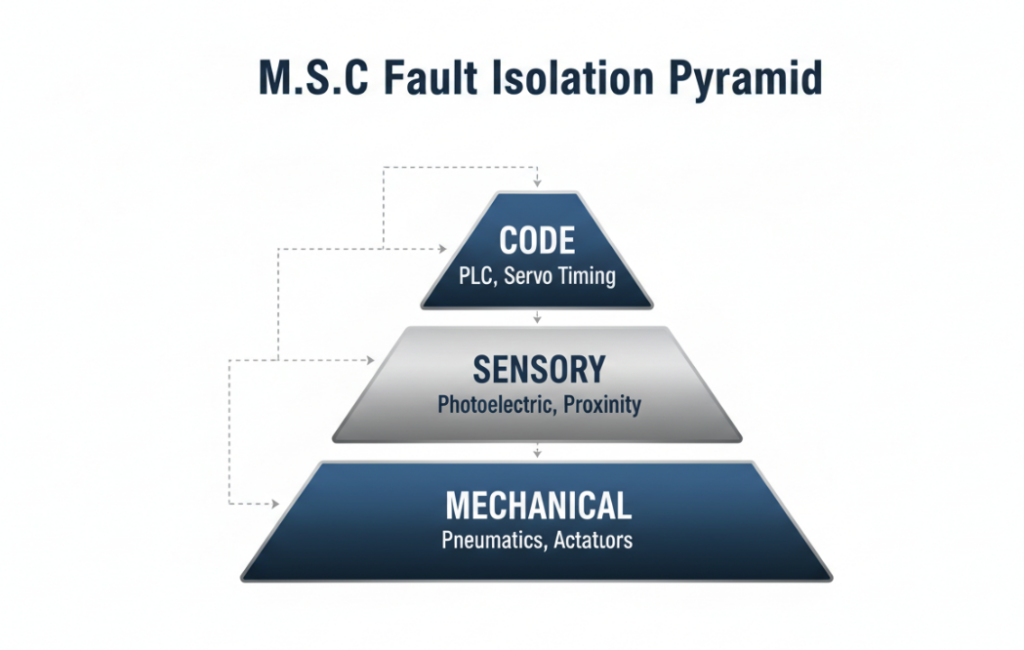
Tier 1: Mechanical And Pneumatic Integrity
Mechanical drift accounts for 65% of all packaging line errors. You must check physical alignments, belt tensions, and pneumatic air pressure drops before ever opening the PLC cabinet. A drop of just 5 PSI in your main airline will cause the sealing jaws to actuate milliseconds late, leading to weak seals that pass visual inspection but fail underwater vacuum tests. Verify cylinder stroke lengths and O-ring lubrication daily.
Tier 2: Sensory Calibration
Photoelectric and proximity sensors degrade due to factory dust and liquid splash. Dust buildup on a retro-reflective sensor lens changes the focal point, causing the PLC to register a “bottle missing” error even when the conveyor is full. Wipe all optical lenses with isopropyl alcohol every 4 hours and verify the reflector alignment using a laser pointer tool.
Tier 3: Code And Servo Timing
Servo motor desynchronization happens when mechanical drag forces the motors to draw more current, slightly altering their timing curves. Never adjust the PLC code to compensate for mechanical wear. If the filling nozzle descends too early, check the vertical axis ball screw for backlash before attempting to add a delay timer in the software interface.
Critical Errors In Volumetric And Liquid Fillers
Liquid and powder dispensing units face unique physics-based challenges. Operators frequently misdiagnose fluid dynamics issues as hardware failures.
The Temperature-Viscosity Lag Trap
Liquid volume inconsistencies are almost always caused by ambient temperature shifts, not failing displacement pumps. As the factory floor heats up by mid-day, the viscosity of liquids like syrups or oils drops. Thinner liquids flow faster, causing slight overfills if the servo valve closing time remains static. Install an inline temperature probe and map your PLC servo closing times to automatically adjust based on the real-time thermal data of the product.
The “Micro-Dosing Air Trap” In Pneumatic Lines
Foaming during the high-speed filling process is a direct result of air ingress through micro-abrasions in the pump O-rings. When negative pressure draws liquid into the dosing cylinder, damaged seals suck in microscopic air bubbles. These bubbles compress during the dispensing stroke, leading to erratic fill weights. Implement a weekly vacuum-decay test on your dosing cylinders. Replace any O-ring that cannot hold a negative pressure of -0.8 bar for 60 seconds.
Preventing Web Tracking And Sealing Failures
Flexible packaging systems utilizing VFFS or HFFS architectures fail when tension and thermal dynamics fall out of synchronization.
Troubleshooting Guide for Packaging Film Defects
| Visual Defect (视觉缺陷) | Root Cause (根本原因) | Immediate Fix (立即修复方法) |
| Wrinkled Seal<br>(Seal is not flat; looks folded or puckered) | – Uneven web tension.<br>- Misaligned sealing jaws.<br>- Worn or damaged Teflon tape on the jaws. | – Adjust the film roll brake to balance tension.<br>- Re-level and parallel the sealing jaws.<br>- Replace the Teflon tape immediately. |
| Leaking Gusset<br>(Pinholes or unsealed gaps where the film folds) | – Insufficient sealing pressure at the thicker folded areas.<br>- Sealing temperature too low.<br>- Gusset tuckers are misaligned. | – Increase jaw pressure or dwell (seal) time.<br>- Slightly increase sealing temperature.<br>- Adjust the mechanical gusset folder alignment. |
| Film Snapping<br>(Web breaks entirely during unwinding or pulling) | – Unwind tension is set too high.<br>- Sharp edges, burrs, or sticky debris on idler rollers.<br>- Edge nick or defect on the raw film roll. | – Decrease unwind brake tension.<br>- Inspect, clean, and lubricate all guiding rollers.<br>- Peel off and discard the damaged outer layers of the film roll. |
| Burned / Melted Seal<br>(Seal area is discolored, brittle, or completely melted through) | – Sealing temperature is set too high.<br>- Dwell time (jaw closed time) is too long.<br>- Machine speed dropped without adjusting heat. | – Lower the temperature controller setpoint.<br>- Reduce jaw dwell time.<br>- Ensure cooling air blasts (if equipped) are functioning. |
| Registration / Tracking Error<br>(Printed graphic is cut off or not centered on the bag) | – Dirty or misaligned eye-mark (photo-eye) sensor.<br>- Worn out or slipping draw-down belts.<br>- Incorrect pitch settings in HMI. | – Clean the photo-eye lens with alcohol and realign to the mark.<br>- Increase pressure on draw-down belts or replace if smooth/worn.<br>- Recalibrate bag length in the control panel. |
Asymmetric Jaw Pressure
A wrinkled seal always indicates asymmetric pressure between the front and rear sealing jaws. Operators often try to fix weak seals by increasing the jaw temperature, which only burns the packaging film and destroys the polymer barrier layer. The correct fix requires using carbon pressure paper. Place the carbon paper between the cold jaws, actuate them manually, and inspect the ink transfer. Adjust the alignment shims until you achieve a solid, uniform ink block across the entire sealing width.
Film Tracking Drift And Dancer Roller Stiction
Film wandering off the forming collar is caused by stiction in the dancer roller bearings, not defective rolls of film. When a bearing seizes, the film tension spikes on one edge, pulling the entire web off-center. Remove the film and spin every idler and dancer roller by hand during changeovers. Any roller that stops spinning in under three seconds has compromised bearings and requires immediate replacement.
Eliminating Phantom Jams With Acoustic Monitoring
A major Midwest beverage facility recently overhauled its approach to maintaining a fleet of high-speed filling and packaging machines. They faced persistent “phantom jams”—the line would stop, indicating a low-pressure fault, but operators could find no physical jam.
The engineering team installed acoustic emission sensors on the primary pneumatic manifolds. The data revealed a high-frequency hiss occurring only during the specific millisecond a diverter valve actuated. The root cause was a hairline crack in a polyurethane air tube that expanded only under maximum dynamic pressure. By switching from visual inspections to acoustic IIoT monitoring, they dropped their unscheduled downtime from 4.2% to 0.3% over six months.
FAQs
Why does my filling machine dispense inconsistent weights?
Inconsistent weights result from trapped air in the dosing cylinders, fluctuating product temperatures altering viscosity, or worn piston seals. Always verify the O-ring integrity and ensure the hopper maintains a consistent head pressure before adjusting the stroke volume.
How often should we lubricate the moving parts of a packaging machine?
Lubrication schedules depend strictly on the machine’s duty cycle and operating environment, but linear bearings and ball screws require inspection every 500 operating hours. Use food-grade, high-temperature synthetic grease for components near sealing jaws to prevent thermal breakdown.
What causes the packaging film to snap during operation?
Film snapping happens when the braking torque on the unwind spindle is set too high or if the dancer arms fail to absorb sudden tension spikes during the indexing phase. Reduce the unwind brake tension and verify all film path rollers spin freely without resistance.
How do you test the seal integrity of a flexible pouch?
Seal integrity must be tested using a vacuum water bath test. Submerge the sealed pouch in the vacuum chamber, drop the pressure to -0.5 bar, and watch for escaping air bubbles. This identifies micro-leaks that visual inspections will completely miss.
Why is my photoelectric sensor missing transparent bottles?
Transparent materials refract light unpredictably. Standard photoelectric sensors fail here; you must upgrade to a clear-object sensor with a polarized retro-reflective lens and a low-hysteresis threshold to detect the slight light attenuation caused by clear plastics or glass.
What is the fastest way to clear a jammed auger filler?
Never use metal tools to pry compacted powder out of an auger funnel. Reverse the auger motor manually via the HMI to relieve the compression, then remove the tooling and flush the funnel with compressed air or warm water, depending on the powder’s solubility.
