 Soonqian
What Is Packing Machine
A packing machine is a type of equipment that automates all or a portion of the packaging process for a product. Its fundamental purpose is to take a product and enclose it within a protective material (like a bag, box, bottle, or film wrap) with high efficiency, consistency, and minimal human intervention. The core process typically involves a sequence of operations such as forming the package, filling it with a set amount of product, sealing it securely, and often labeling or coding it. Ultimately, these machines are engineered to replace manual labor, aiming to dramatically increase production speed, ensure uniform package quality, improve hygiene standards (which is critical in the food and pharmaceutical industries), and reduce long-term operational costs for businesses.
The Core Process Of The Packaging Machine
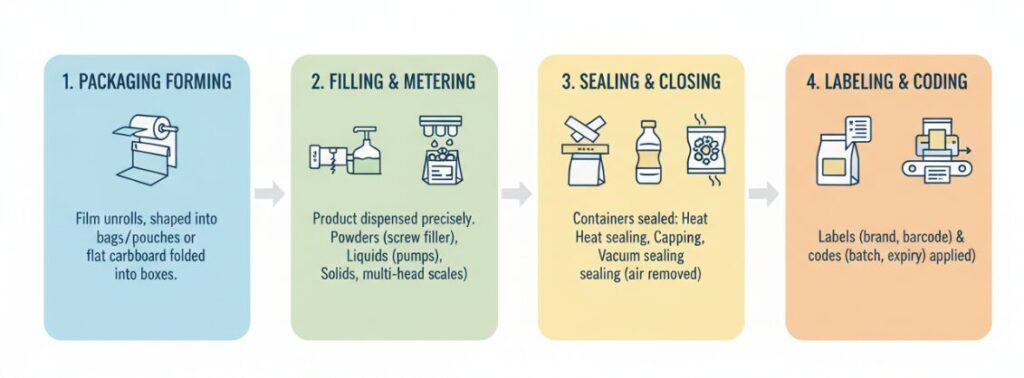
Although the specific operation will vary depending on the type of machine and product, the automated packaging process basically follows a core sequence.It is this series of steps that ensures that each product can be packaged uniformly and ready for subsequent logistics distribution.
Packaging molding: the whole process begins with the production of the container. Take a vertical form-fill-seal (FFS) machine, which shapes entire roll of flat packaging film directly into a bag or pouch. In other application scenarios, such as a carton forming machine, it will automatically fold the flat cardboard into a box.
Filling and metering: Once the container is formed, the machine fills it with a precise amount of product. According to my experience, the choice of filling mechanism depends entirely on the physical properties of the product, which is also the most error-prone place in the selection. For example, screw filling machines are designed to handle powders; liquid filling machines control fluids through pumps or pistons; and multi-head scales are used for solid materials such as snacks to ensure that the weight of each package is accurate.
Sealing and closing: After filling, the package must be securely closed to protect the product inside. There are a variety of ways to seal, such as fusing plastic materials through heat sealing technology, or screwing caps on bottles and cans with a capping machine. Sometimes vacuum sealing is also used, that is, to remove the air from the package before sealing, mainly to extend the shelf life of perishable goods.
Labeling and coding: In the final stage, many machines will automatically apply labels with key product information, brand identification and bar codes. They may also print batch numbers, shelf life and other traceability information, which is essential to meet regulatory requirements and achieve product traceability.
The Key Advantages Of Automated Packaging
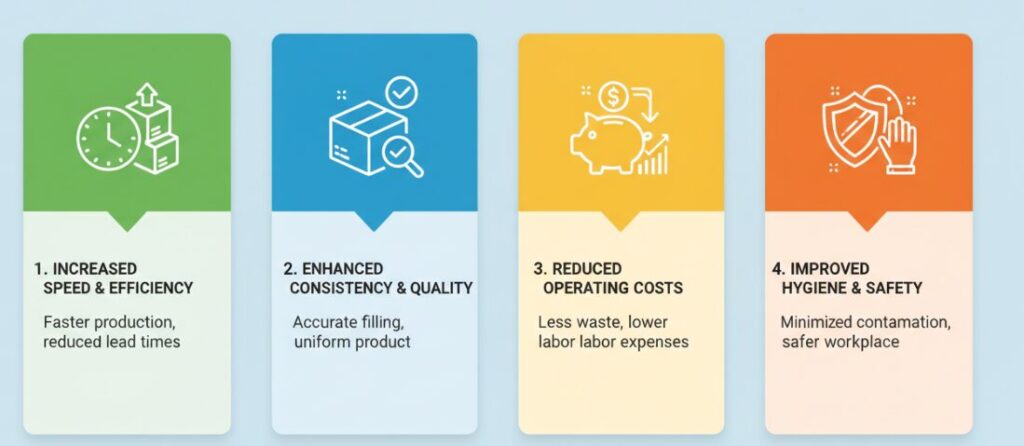
The integration of automated packaging machinery into the production line, compared to traditional manual operations, the advantage is very significant, it can directly improve efficiency and profitability.By replacing repetitive and labor-intensive tasks, these machines optimize the entire operational process from start to finish.
Increase production speed and efficiency: Automated systems can work tirelessly and continuously at high speeds, packing hundreds of products per hour.This sharp increase in production allows companies to cope with rising market demand, reduce production bottlenecks, and shorten the lead time for orders.
Enhance consistency and quality: The advantage of the machine is its accuracy, it can eliminate the errors and inconsistencies common in manual packaging. This ensures that each package is filled with just the right amount, tightly sealed, and accurately labeled, which ultimately leads to uniform product quality and higher customer satisfaction.
Reduce operating costs: Although the initial equipment investment may be expensive, in the long run, packaging machines can actually reduce expenses.It reduces waste by precisely controlling the amount of material packaged per 1, while minimizing dependence on manual labor, thereby saving a lot of labor costs.
Improve hygiene and safety standards: Automation is essential in industries with high hygiene requirements such as food, beverage and pharmaceuticals. The machine minimizes direct human contact with the product, thereby reducing the risk of cross-contamination. In addition, it takes over repetitive or high-intensity tasks that may result in work-related injuries, improving overall workplace safety.
The Common Types Of Packaging Machines
“Packaging machine” is actually a fairly broad term that covers a wide variety of devices designed for different functions and industries.Let me briefly list some of the most common types to give you a general idea:
Palletizers: Usually located at the end of a production line, these machines automatically stack and arrange boxes or products onto pallets in preparation for bulk shipment.
Filling machine: specially used to accurately fill liquid, powder, granular or paste products into containers.
Wrapping machines and sealing machines: These categories include shrink packaging machines that make the film close to the contours of the product by heating, and stretch winding machines used to fix the goods on pallets for transportation.
Cartoning machine: This type of machine can automatically form the carton, load the product, and complete the sealing box.
Labeling machine: used to paste pre-printed labels on various types of packaging (such as bottles, cans and boxes).
Author :Dylan
With over a decade of experience in the manufacturing and industrial automation sector, I’ve had a front-row seat to the evolution of packaging technology. My passion lies in breaking down complex machinery concepts to help businesses understand how automation can revolutionize their production lines.