 Soonqian
How To Choose The Right Packaging Machine
In order to successfully choose a packaging machine, the blanking system should be finalized according to the physical characteristics of the product (such as viscosity, fluidity or fragility). Then calculate your capacity demand (PPM) and see whether to choose a flexible semi-automatic or a speed-seeking full-automatic production line. Third, you must ensure that your packaging material (such as PE film or composite film) matches the sealing form of the machine. Fourth, don’t just stare at the purchase price of equipment, to calculate TCO (total cost of ownership), take into account the change time, energy consumption and spare parts. Finally, try to choose those machines with general electric components (like standard PLC).
Step1: Analysis Of Product Characteristics, Select Feeding System
The first step in choosing a packaging machine is also a step that many people are easy to step on. It is necessary to conduct a thorough “physical examination” of your product’s physical state “. The core of any packaging system is the blanking or filling mechanism. If this piece is not matched properly, it will be inefficient and wasteful to do whatever it takes.
- Viscosity: In the case of liquids and pastes, viscosity determines everything. For high-viscosity products such as peanut butter, a heavy-duty piston filling machine must be used to push out the materials. However, for low-viscosity products such as water, gravity filling or flow meter is sufficient.
- Liquidity: When it comes to powder packaging, liquidity is the key. Like white granulated sugar, which has good fluidity, just use a volumetric measuring cup. However, for powder such as flour, which has poor fluidity and is easy to raise dust, it is necessary to use screw metering to press down the material through forced driving and control the dust at the same time.
- Friability: Solid products depends on how “delicate” it is “. Frangible items such as potato chips or biscuits must be covered with a cushioned multi-head scale (MHW) to prevent the material from breaking into slag when it falls. As for those bulk goods that are solid and durable, simple linear scales can handle it completely.
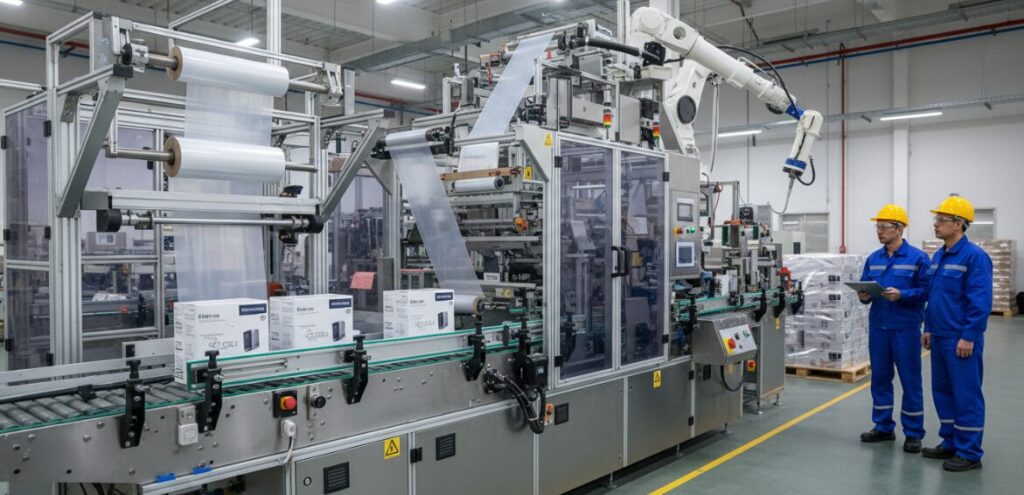
Step2: Calculate The Capacity Demand: Semi-Automatic Or Fully Automatic?
Clarifying your requirements for speed can help you spend your money on the blade. Your target yield, which is packs per minute (PPM), directly determines what level of automation you need.
- Semi-automatic solution: If your production line needs to change products frequently, or the output requirements are not high (such as less than 15-20 packs a minute), semi-automatic machines are usually a more rational choice. They have a low threshold and extremely high flexibility, the only price being the need for manual assistance.
- Fully automatic production line: But if your goal is high-volume mass production (such as 50-100 PPM), speed priority, then don’t hesitate to go directly to the fully automatic vertical (VFFS) or horizontal (HFFS) packaging machine. Although the cost of the initial investment looks quite high, if you stretch the time and spread it over the labor cost of each product, this account is definitely worth it.
Step3: Ensure The Compatibility Of The Packaging Material And The Sealing Knife Seat
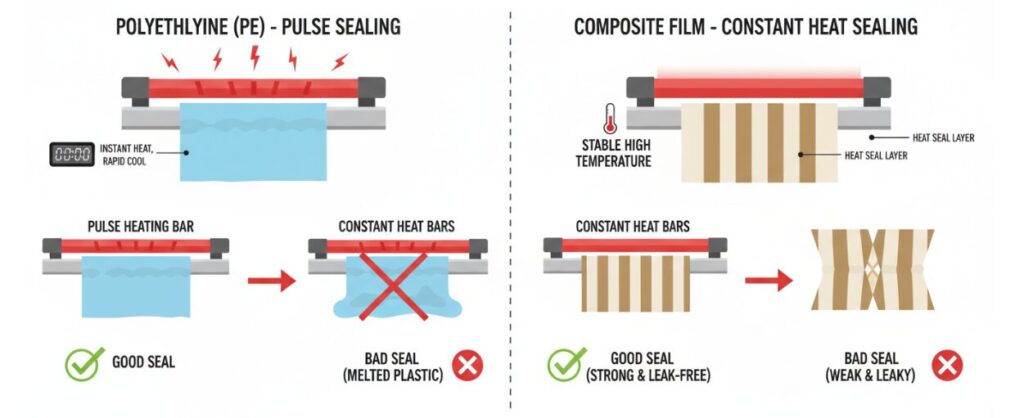
Sealing quality is good or bad, depends entirely on the film material and machine sealing technology interaction.
- Polyethylene (PE): PE is a single-layer film and must be sealed with pulses. This technique is instantaneous heating and then rapid cooling shaping. If you try to seal the PE film with constant heat, the result will only be lumps of melted rotten plastic.
- Composite film: multilayer composite film requires constant heat sealing. The knife seat must maintain a stable high temperature in order to penetrate the thick film layer and stick the heat seal layer inside. Select the right sealing assembly to ensure that the bag is not leaked and the freshness of the product is locked.
Step4: Analyze Total Cost Of Ownership (TCO)
When an expert buys equipment, he never just stares at the number on the quotation. To really choose the right packaging machine, you have to calculate the total cost of ownership (TCO) of the machine’s entire life cycle.
- Change time: This is often overlooked. How long does it take to change from one bag to another? Those machines with a “tool-free disassembly” design can save you hundreds of hours of effective production time a year.
- Energy consumption: look at the gas circuit and circuit requirements. Today’s modern machines are mostly servo-driven, and the electricity bill will look much better than those old purely pneumatic designs.
- Availability of spare parts: is the consumable material (like teflon adhesive tape, cutter and heating tube) expensive? is it good to buy? some machines look cheap, but if the subsequent replacement parts are all exclusive and expensive, that is the real bottomless pit.
Step5: Maintenance Convenience: Adhere To The Selection Of General Electric Components
Finally, how long your packaging line can run stably depends on what is in the electric control cabinet.
- Maintenance convenience: This is crucial. If a special circuit board made by a manufacturer is broken, you have no other way but to wait for the manufacturer to deliver the goods. The may stop for several weeks. However, if the standard PLC or driver is broken, the mechanical and electrical market downstairs or the local agent can transfer the goods immediately.
- Long-term operation guarantee: machines with open standard electronic components are easy to upgrade and eliminate. This means that your equipment can run for decades, rather than being scrapped after a few years because you can’t buy accessories.
As long as you evaluate these 5 aspects-product characteristics, production capacity, material compatibility, TCO and component standards-you can jump out of the of fancy parameter tables and choose the packaging machine that really suits your production goals.
Author: Robert Miller
Hi, I’m a Senior Packaging Engineer with over 16 years of experience in industrial automation. I specialize in helping manufacturers optimize their production lines by analyzing material characteristics, TCO, and PLC integration.