
 Soonqian
Machine for Packaging: Find Your Ideal Package Machin
Finding the right Machine for Packaging is by no means as simple as buying a device against the parameter table. In essence, the ideal package machine must be closely matched to your product physical form, target capacity (PPM), and film material. However, the reality is that a large number of B2B buyers who come into contact with automation for the first time spend 30% more money on useless fancy functions, or suffer heavy losses in the later “sky-high” proprietary spare parts and long line-changing shutdowns. This article does not talk about the old sales nonsense. Next, I will give you the technical evaluation framework and TCO (total cost of ownership) accounting cards that the head factory integrator is really using directly to help you avoid all procurement minefields.
P.A.C.K. Selection Matrix: A Practical Evaluation Framework for B2B Buyers
Just look at the supplier’s brochure to set the equipment, the pit stepping rate is extremely high. Before asking the manufacturer for a quote, use this set of P.A.C.K. matrices to reverse-deduce your real needs.
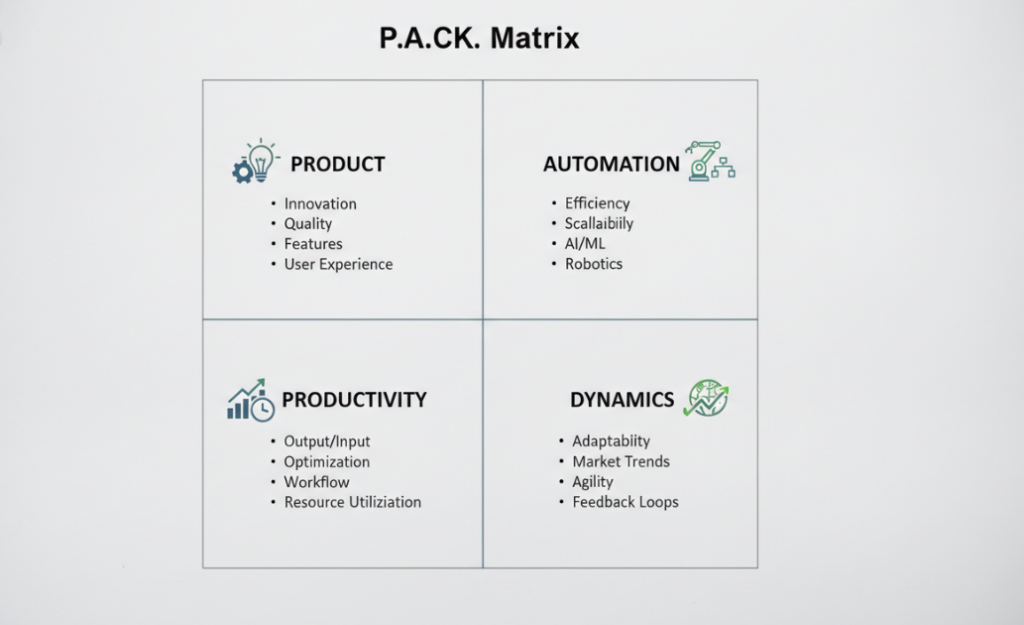
P (Product) product morphology determines the feeding mechanism. Solid particles (such as nuts or hardware) must be equipped with a multi-head scale, while high-viscosity liquids can only be used with plunger pumps. Many factories did not understand this step thoroughly and chose the wrong filling head specifications. The final result was that the long-term material clamping and rejection rate at the sealing area remained high.
A (Automation) The degree of automation is directly linked to manual dependence. Semi-automatic equipment requires workers to keep an eye on materials and loading and unloading parts throughout the process, while the fully automatic production line can be directly connected with the upstream conveyor belt. Don’t blindly pursue full automation, calculate 1 local packer wages and depreciation of fully automatic equipment, find that real break-even point is the insider’s approach.
C (Capacity) capacity planning must be redundant. If your current capacity demand is 50 PPM (bags/minute), don’t buy equipment with a maximum speed limit of 50 PPM. Sophisticated buyers will decide on the machine according to the predicted production capacity in the next 3 years, plus an additional 20% margin, so as to avoid the equipment being forced to be eliminated just two years after it is launched.
K (Kinematics) dynamics and materials determine run accuracy. Now the whole terminal market is going to degradable environmental protection film, which is extremely demanding on the tension control of the equipment. The old pneumatic or pure mechanical structure can’t be fine-tuned at all. To not break the membrane frequently, the servo-driven (Servo-Driven) system is the only solution.
Packaging machine classification logic: seamless connection between machine architecture and production line
By disassembling the equipment according to the primary and secondary functions, you can clearly know where each machine should be placed in the workshop.
Primary packaging equipment (vertical and horizontal)
The task of the first level of packaging is to put the naked product in the first layer of “protective clothing”. The vertical form-fill-seal machine (VFFS) is the absolute workhorse in the snack and powder industries, as it directly uses gravity to let the material fall into the bag formed from the roll film. The horizontal packaging machine (HFFS, or pillow charter machine) is responsible for pushing these blocks of baked cakes and trays horizontally into the film to complete the package.
Secondary and end-of-line packaging
The core of the secondary system is “packaging and packaging” for subsequent logistics and retail shelves. Box packers, heat shrinkers and palletizing robots take over the heavy work at the end of the line. In order to prevent primary packaging and secondary equipment from getting stuck, the PLC (programmable logic controller) communication protocol between the two must be completely opened, otherwise the upstream machine will frequently stop due to downstream blocking.
Purchase to avoid pits: manufacturers will never take the initiative to tell you the TCO iceberg trap
The money paid when buying a machine usually accounts for less than 40% of the 5-year full life cycle cost (TCO) of the equipment. Many equipment manufacturers (OEM) in the early bare metal prices are very low, in order to rely on the late non-standard accessories and expensive after-sales maintenance to make profits back.
5-Year Total Cost of Ownership (TCO): Cheap Pneumatic vs. High-End Servo Packaging Machine
| Cost Category (5-Year Projection) | Cheap Pneumatic Packaging Machine | High-End Servo Packaging Machine | 5-Year Difference & Impact |
| 1. Initial Equipment Purchase | $20,000 | $50,000 | +$30,000 (Servo requires higher upfront investment) |
| 2. Electricity Cost (Energy) | $36,500 | $2,000 | -$34,500 (Servo saves ~90% energy vs. compressed air) |
| 3. Maintenance & Labor | $15,000 | $4,000 | -$11,000 (Servo eliminates seal/valve replacements) |
| 4. Consumable & Material Waste | $25,000 | $5,000 | -$20,000 (Servo precision stops film/product scrap) |
| 5. Unplanned Downtime Cost | $18,000 | $5,000 | -$13,000 (Servo reliability prevents production halts) |
| Total 5-Year TCO | $114,500 | $66,000 | Servo saves overall $48,500 in 5 years |
Monopolizing non-standard accessories is a bottomless pit that devours maintenance budgets. Some manufacturers will deliberately make sealing cutters and mounts into non-standard parts. When your blade is blunt, you need to change it. I’m sorry, I can only find them to buy it. The price will triple directly. Before signing the contract, it must be required that the vulnerable parts such as cylinders and sensors must be common standard parts that can be seen everywhere in the market such as Festo, SMC or Omron.
Line change downtime (Changeover downtime) is the invisible killer of capacity. From a small bag of 100 grams to a large bag of 500 grams, the machine designed to collapse allows line workers to toss for 45 minutes with a wrench. Really easy-to-use equipment has a tool-free quick mold change (Tool-less changeover) design, which can change the molding device and guide rail with bare hands within 10 minutes, which can give the boss hundreds of hours of pure production time in a year.
Exclusive Case: How to Cut Down 65% of Line Change Downtime
A medium-sized snack factory in Ohio found during a production line audit that they wasted 12 hours a week just because they changed the size of their bags. Later, they completely eliminated three old pneumatic machines and replaced them with a servo-driven package machine with formula memory function and tool-free mold change.
Measured running line data: single line change time from 45 minutes to 12 minutes. The overall efficiency of the equipment (OEE) has increased by 14%, and thanks to the precision of the servo motor, the coating loss rate has also decreased by 18%.
Industry frontier: environmental protection film fault tolerance rate and OEE data island
The current terminal market forces B2B procurement to be forward-looking. The equipment bought must not only withstand the toss of new materials, but also keep up with the rhythm of digital workshops.
Degradable environmental protection film is the “demon mirror” of the old machine “. Environmentally friendly packaging materials are usually brittle, and the heat sealing window period is extremely narrow (the temperature is higher on the hot wear, lower and not sealed). If you buy a traditional pneumatic packaging machine cheaply, high scrap rates and frequent film breaks are doomed. Only modern servo machines with millisecond temperature control and precise jaw pressure can run these fragile new materials smoothly.
OEE direct connection is already a hard indicator of modern factories. Top procurement experts have long since stopped using the “information island” dumb machine. The newly purchased packaging machinery must have an open architecture PLC, which can throw real-time data such as startup rate, rejection rate and circulation speed to the ERP or MES system of the factory with one click, so as to make the capacity data fully transparent.
FAQ
What is the difference between primary and secondary packaging machines?
The first-class machine directly contacts exposed products (such as putting potato chips into plastic packaging bags); The second-class machine packs these bagged finished products into large cartons for truck delivery.
industrial grade package machine about how much does it cost?
Entry-level semi-automatic devices can land for almost $5,000. However, if it is a high-end fully automatic production line with high-speed, full servo drive and automatic docking, the price will be over US $30,000 to US $150,000, depending on the production capacity and the hygiene level requirements of the whole machine.
Can ordinary packaging machines use environmentally friendly degradable films?
It is extremely difficult to run smoothly. Old-fashioned pneumatic equipment lacks precise tension control and temperature control. To use degradable materials and not produce large amounts of waste film, you must use modern models with servo motors and high-precision sealing jaws.
What does VFFS mean in the device parameters?
The full name of VFFS is Vertical Form Fill Seal (vertical forming, filling and sealing machine). This is the 1 full-automatic vertical film walking equipment. The machine rolls the flat film of the 1 into a tubular bag, and at the same time, the product is poured into it from above, and finally the seal is cut off instantly.
How is the TCO (Total Cost of Ownership) of packaging equipment calculated?
Don’t just stare at the purchase price of bare metal. The purchase price of the machine, plus freight, installation fee, estimated maintenance premium for the next 5 years (parts plus labor maintenance contract), energy consumption cost, and the loss of work delay and waste film cost caused by daily line change and shutdown, is the real price you pay.
How long does it usually take for the machine to change the line (change the packaging size)?
If it is an old machine that needs to be dismantled one by one with a wrench, it will take 30 to 60 minutes to change the mold. New machines with formula memory parameters and support tool-free adjustment can be completed in 5 to 15 minutes.
