
 Soonqian
Packaging Machines: Selection Guide & Efficiency Optimization
The value of packaging equipment is far more than just “increasing packaging speed”. For production-oriented enterprises, a stable packing machine can bring long-term benefits in multiple links such as product consistency, material loss, manual management and transportation efficiency.
Especially in the food, daily and industrial packaging sectors, as order sizes and packaging standards continue to increase, companies are placing higher demands on the stability, flexibility and continuous operation capabilities of packaging equipment.
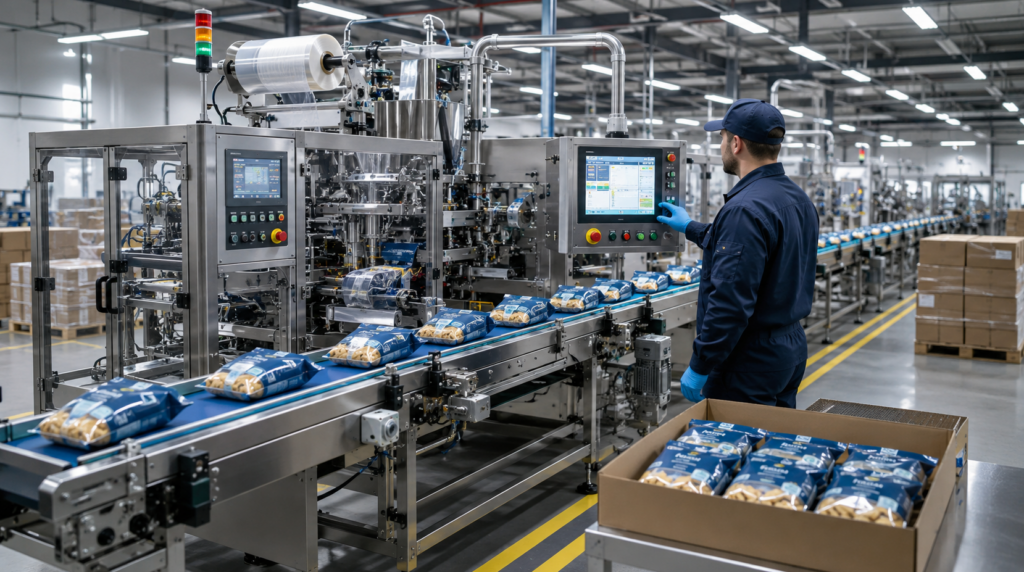
What Is Packaging Machine? It Really Doesn’t Solve “Packaging”, But Stable Delivery
Packaging machine generally refers to automated equipment used in processes such as product metering, forming, filling, sealing, labeling, boxing, and palletizing. It can be a single machine or a whole packaging machinery production line.
When many lay customers first encounter packaging machines, they focus on speed, such as “how many packs can be made per minute”. But the factors that really affect investment returns are the following:
- Whether the product is suitable for: powder, granules, liquid, paste, fragile products, special-shaped parts, the requirements for machine for packaging are completely different.
- Whether the packaging material is stable: PE, PP, composite film, paper bag, aluminum foil bag, pre-made bag, has an impact on the sealing temperature, film drawing accuracy and tension control.
- Whether the equipment structure is durable: stainless steel frame, servo motor, PLC control, food grade contact material, determine whether the equipment can operate with high intensity for a long time.
- Is it easy to change the shape: If you have multiple specifications, mold switching, parameter preservation, and cleaning convenience are more important than simple speed.
A good packing machine not only puts products into bags, but also reduces manual errors, material waste, poor packaging rate and delivery instability.
The Underlying Logic Of Packaging Machine: Why Does It Improve Efficiency?
The Metering System Determines The Packaging Accuracy
Different products need to match different measurement methods:
Screw metering is commonly used for powder products, such as milk powder, coffee powder, and flavoring powder. Multi-head scales are commonly used for granular products, such as nuts, candies, and frozen foods. Piston pumps, rotary pumps or flow meters are commonly used for liquids and pastes, such as sauces, laundry detergents, and cooking oils.
For insider procurement, precision is not an isolated parameter. For example, an error of ±1g has little effect on low-priced products, but in high-value powders, health products or freeze-dried foods, it will become a significant material loss in the long run.
Forming And Sealing System Determines Packaging Qualification Rate
During packaging machine packaging, sealing quality is the most overlooked but most prone to problems.
Common questions include:
Untight seal, pinching, air leakage, uneven cut, bag deformation, date printing offset. These problems are often not caused by a single cause, but are the result of a combination of material thickness, temperature control, pressure, knife seat accuracy, and feed synchronization.
High-quality industrial packaging machines usually use servo film pulling, PID temperature control, photoelectric tracking and mechanical anti-bias design to make the packaging action more stable.
Control System Determines Operating Threshold
Modern pack machines generally use PLC+touch screen control. For factories, a good control system should do:
Parameters can be saved, so there is no need to re-debug when changing specifications; alarm information is clear, and maintenance personnel can quickly locate faults; key components are modular and easy to replace; language switching is supported to facilitate operation in overseas factories.
This is also why, also called packing machines, some equipment is cheap but difficult to tune, while others are more expensive but can reduce downtime.
How To Choose Different Packaging Solutions? Don’t Just Look At The Price
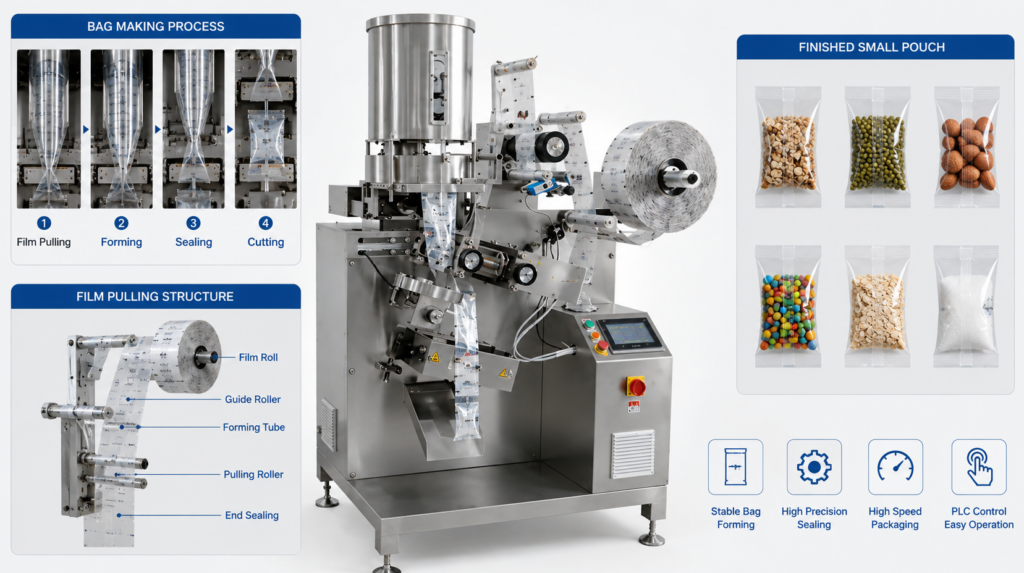
Vertical Packaging Machine: Suitable For High-efficiency, Small Bagged Products
Vertical packing machine is suitable for granular, powder, small pieces of products such as rice, coffee, sugar, nuts, potato chips, frozen foods.
The advantages are fast speed, small area and high degree of automation; the disadvantages are high requirements for packaging film quality, and special design of blanking structure is required for special-shaped products or fragile products.
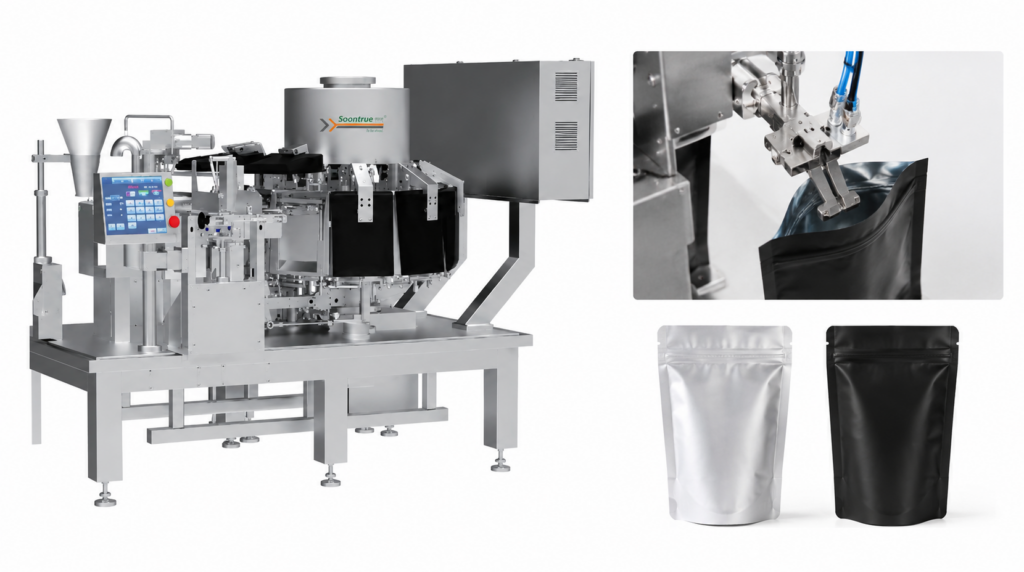
Bag Packaging Machine: Suitable For High-end Pre-made Bag Packaging
The bag packing machine is suitable for stand-up bags, zipper bags, and special-shaped bags, and is often used for pet food, nuts, condiments, and high-end food packaging.
The advantage is that the packaging looks good and has a strong brand sense; the disadvantage is that the cost of pre-made bags is higher and the speed is generally lower than that of vertical packaging machines.
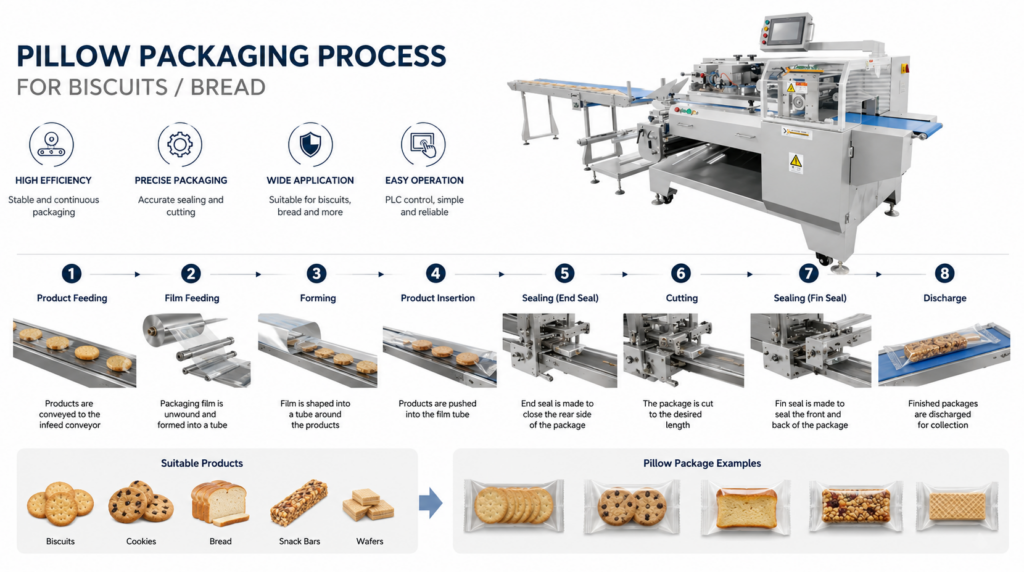
Horizontal Packaging Machine: Suitable For Strip, Block And Regular Products
Horizontal packaging machine is suitable for products such as biscuits, bread, chocolate, hardware, daily necessities, etc.
Its advantage is high efficiency of continuous packaging, suitable for large-scale production; but if the product size changes frequently, it must focus on the difficulty of machine adjustment.
Food Packaging Equipment: Hygiene And Cleanliness Are More Critical Than Speed
The biggest difference between food packaging equipment and ordinary industrial equipment is the sanitary design.
High-quality food packaging machines should have 304 or 316 stainless steel contact surfaces, no dead-angle design, quick-release structure, waterproof electrical layout and easy-to-clean conveying system. For products such as meat, frozen foods, and sauces, cleaning convenience directly affects food safety and downtime costs.
The Easiest Pit To Step On When Purchasing A Packaging Machine
Only Ask About Price, Not Product Testing
Professional manufacturer of packaging machine will definitely recommend you to provide samples, packaging materials and target bag type. Because the packaging effect cannot be judged by drawings alone, it must be confirmed by physical testing.
It is recommended to confirm at least before purchasing:
Product flowability, particle size, moisture content, whether it is fragile, whether it is powdery, target grammage, bag width and bag length, packaging speed, and packaging material thickness.
Ignore Spare Parts Supply Cycles
Cheap equipment does not mean low total cost. What really affects production is the supply of fragile parts, such as blades, heating tubes, synchronization belts, suction cups, sensors, sealing strips, etc.
If spare parts have to wait 4-6 weeks, the loss of one day of equipment downtime may be much higher than the original purchase cost saved.
No Consideration Of Later Extensions
Many customers only bought a single machine in the first stage. Six months later, they wanted to add conveyors, metal inspection machines, checkweighers, and box packers, but found that the original equipment interfaces were insufficient.
If you have plans to expand production in the future, it is recommended to confirm at the beginning whether the equipment supports production line linkage, signal interface, reserved space and automatic loading system.
Cost Optimization: Where Real Savings Are Made Isn’t In Equipment Quotes
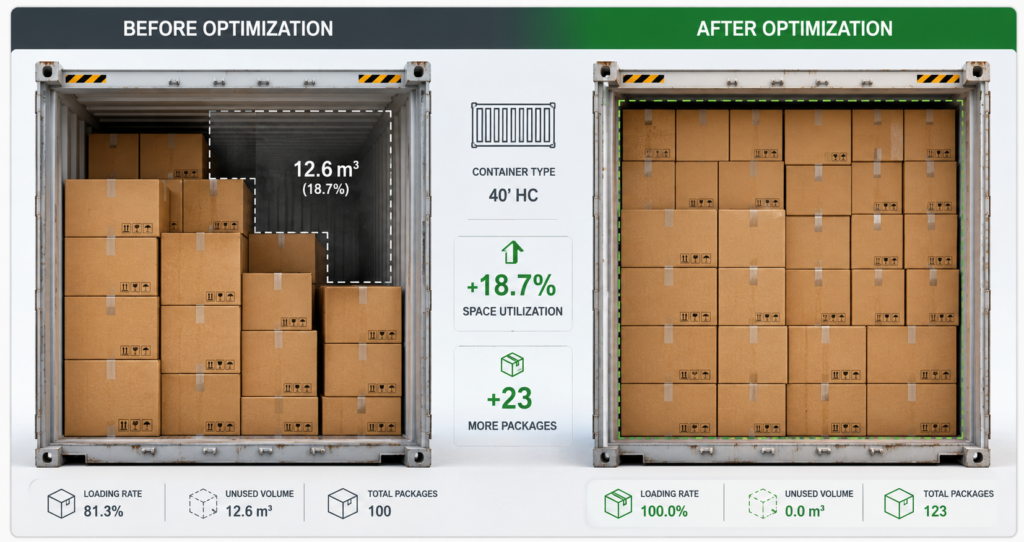
Reduce Logistics Costs Through Packaging Size Optimization
For the export market, package size is more important than many people think. Taking the European and American markets as an example, maritime transportation, truck distribution and warehousing are all affected by volume.
If the bag type is optimized, the packing method is adjusted, and the void ratio is reduced, the loading capacity of a single box can be increased by 10%-20%. This means that the same container can hold more finished products, which can significantly reduce unit transportation costs in the long run.
Select The Appropriate Automation Level
Not all plants require fully automatic lines. For customers who are just starting out, a semi-automatic packaging machine may be more flexible; for customers with stable orders and high labor costs, a fully automatic packaging machine may be more cost-effective.
The judgment criteria are simple:
If the daily production time is short, there are many SKUs and the changes are frequent, flexibility is given priority. If the volume of a single product is large, labor costs are high, and quality requirements are stable, priority will be given to automation.
Control Of Packaging Material Loss
A stable machine for packaging can reduce material waste through precise film drawing, stable sealing, and automatic deflection correction. Do not underestimate the 1% – 2% loss difference, for food factories with large daily packaging volumes, the annual savings can be very considerable.
Logistics/Transportation Strategy: Packaging Equipment Export Can’t Just Look At FOB Prices
For target markets such as Europe, America, Southeast Asia, and the Middle East, it is recommended to focus on the following when purchasing packaging machines.
MOQ And LCL Recommendations
If you only purchase one small packing machine, you can choose LCL LCL, but make sure the equipment is packed in wooden boxes, moisture-proof film, vacuum rust-proof treatment, and fixed base.
If you purchase a full-line food packaging machine, it is recommended to use FCL as much as possible to reduce the risk of collisions caused by transfer handling.
Customs Clearance Information Must Be Prepared In Advance
Common customs clearance materials include commercial invoices, packing lists, bills of lading, certificates of origin, CE documents, electrical drawings, equipment manuals, HS Code recommendations, etc.
For the EU market, CE compliance, electrical safety and food contact material instructions are particularly important. For the US market, customers should also pay attention to local voltage, plug standards, food production environment requirements, and insurance requirements.
Packing Scheme Must Be Done Before Transportation
Professional manufacturer will provide equipment size, weight, wooden box size, cabinet drawing and center of gravity description before shipment. In large industrial packaging machines, special attention should be paid to lifting points, forklift spaces and anti-tip designs.
After the equipment arrives at the factory, it is recommended to check the appearance of the wooden box first, and then unbox and check the spare parts, tools, electrical cabinets, instructions and video installation information.
Typical Application Scenarios
- Scene: Coffee powder and milk powder packaging
Suitable for screw metering + vertical packaging machine. Focus on dust control, sealing, metering accuracy and nitrogen filling function. - Scenario: Nuts, candy, freeze-dried fruit packaging
Suitable for multi-head scale + vertical packing machine or bagging machine. Focus on weighing speed, breakage rate and bag shape aesthetics. - Scene: Sauce, honey, liquid condiment packaging
Suitable for pump body metering + bag feeding or vertical liquid packaging machine. Focus on drip-proof, easy-to-clean and sealed pinch issues. - Scene: Hardware and Industrial Parts Packaging
Suitable for counting machines + packing machines. Focus on abrasion resistance, counting accuracy, and delivery system strength. - Scene: Pet food packaging
Suitable for multi-head scale + pre-made bag packaging system. Focus on large gram packaging, zipper bag opening success rate and closure fastness.
FAQ: Most Frequently Asked Questions About Packaging Machine Customers
- What is the difference between Packaging machine and packing machine?
In actual procurement, the two are often used interchangeably. Packaging machines are more formal and cover a wider range of areas; packaging machines are more commonly used for spoken language and specific device searches. Whether searching for packaging machines or packaging machines, the key is to see whether the product type, packaging form and automation requirements match. - What configurations should Food packaging equipment focus on?
The focus is on food contact materials, cleaning structure, sealing stability, dust and water resistance design, and whether it supports the linkage of gold inspection machines or checkweighers. For food packaging machines, it is not recommended to choose only low-priced equipment because of the long-term risks posed by sanitary dead spots and cleaning difficulties. - How to determine whether a manufacturer of packaging machine is professional?
Look at three points: whether you are required to send samples for testing; whether you can provide clear videos, drawings and plans; whether you can explain why a certain model is recommended instead of just quoting the lowest price. Truly professional manufacturers will pay attention to product characteristics, packaging materials, production capacity targets, sales back-up and transportation plans. - Is the more automatic the Industrial packaging machines, the better?
Not necessarily. The higher the degree of automation, the higher the requirements for operators, maintenance capabilities and order stability. If the SKU changes frequently, excessive automation will actually increase the tuning time. The best option is not the most expensive, but the one that is best suited to current capacity and future expansion. - Do you have to do a test before purchasing food packaging machinery?
It is recommended to do it. Especially powders, liquids, friable particles, oily foods and special-shaped products. Sample testing can detect problems such as blanking, sealing, clamping, breakage, and unstable speed in advance, avoiding modification after the equipment arrives at the factory.
In Summary: Buying Packaging Machine Is Essentially Buying Stable Production Capacity
The value of a good packaging machine is not just to replace manual labor, but to optimize production efficiency, packaging consistency, material loss, logistics costs and delivery stability.
Before purchasing, it is recommended that you prepare product samples, packaging materials, target bag types, production capacity requirements, factory voltage, target market and budget range. Then have suppliers come up with a plan based on real testing, rather than just looking at a quote sheet.
Professional advice: Before placing an official order, the manufacturer is required to provide test videos, equipment configuration lists, fragile parts lists, packing sizes, after-sales support plans and future expansion suggestions. This way you’re not buying a machine, but a packaging solution that works sustainably.
