
 Soonqian
How Does A Strapping Machine Work
The strapping machine works by automatically wrapping a strong strap (plastic or metal) around the product, pulling it tight, sealing the ends (usually by heating or rubbing), and then cutting off the excess, thereby securing the item for transportation. Sensors guide the entire process, ensuring the speed and efficiency of large-volume packaging, from simple manual feeding to fully automatic conveying systems.
This video demonstrates how a manual strapping tool works:
Six Key Steps Of Packaging
To understand why the baler is so fast, we have to break it down into six precise mechanical movements.
Step 1: Feeding The Strap
It all starts with the reel. The motor inside the machine drives the rollers to pull the packing belt (usually PP, PET or steel belt) out. The purpose of these rollers is not only to pull the belt, but more importantly to ensure that the belt enters the internal guide rail smoothly and without knotting. Once the tape is curled here, the whole machine has to stop working.
Step 2: Precise Positioning
After the strap is in place, the sensor (usually a photoelectric or proximity sensor) will monitor at the package. When the goods reach the predetermined position of the workbench, the sensor immediately gives orders. In the fully automatic model, the belt will follow a track called “frame” around the circle. You can think of it as a dedicated runway for the tape to ensure that the product is perfectly wrapped every time.
Step 3: Tensioning For Stability
Tightening is probably the most critical part of the whole movement. The machine will quickly reverse pull the strap so that it is close to the product.
- Adjustability: High-end models allow the operator to fine-tune the pulling force.
- Load Sensitivity: The pulling force of packing cartons should be reduced, otherwise the cartons will collapse. If you pack wood or bricks, the pulling force must be full, otherwise they will definitely fall apart during transportation.
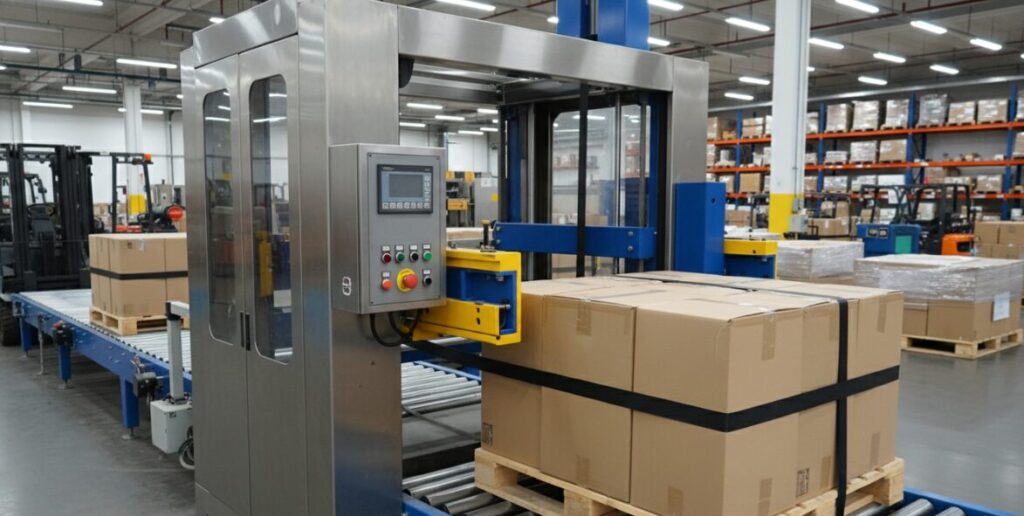
Step 4: Advanced Sealing Technology
After the strap is tightened, the overlapping ends must be securely welded. The specific welding method depends on the material and machine grade:
- Hot Melt Sealing: a heating piece is extended to iron the end of the tape, and then pressed tightly.
- Friction Welding: local high temperature is generated by high frequency vibration, so that the two layers of plastic tape are instantly fused. This method is now very mainstream, especially when packaged with PET tape, it is extremely efficient and does not require heating pipes.
- Metal Seal: For heavy steel belt packaging, the machine will press a metal clip or press the interlocking structure directly on the steel belt.
Step 5: Accurate Cutting
The seal is fixed, the built-in hardened steel knife will cut off the connection of the supply end. This knife must be tightly sealed, and no “tail” or waste of materials can be left after cutting, so that the packaging will appear professional.
Step 6: Pop And Cycle Reset
Finally, the package leaves. For a semi-automatic machine, the package needs to be moved manually, while the fully automatic transmission line is directly sent to the next station by rollers. At this time, the machine will immediately pre-feed the strap into the arch/track. This “seamless” design is the soul of improving production capacity.
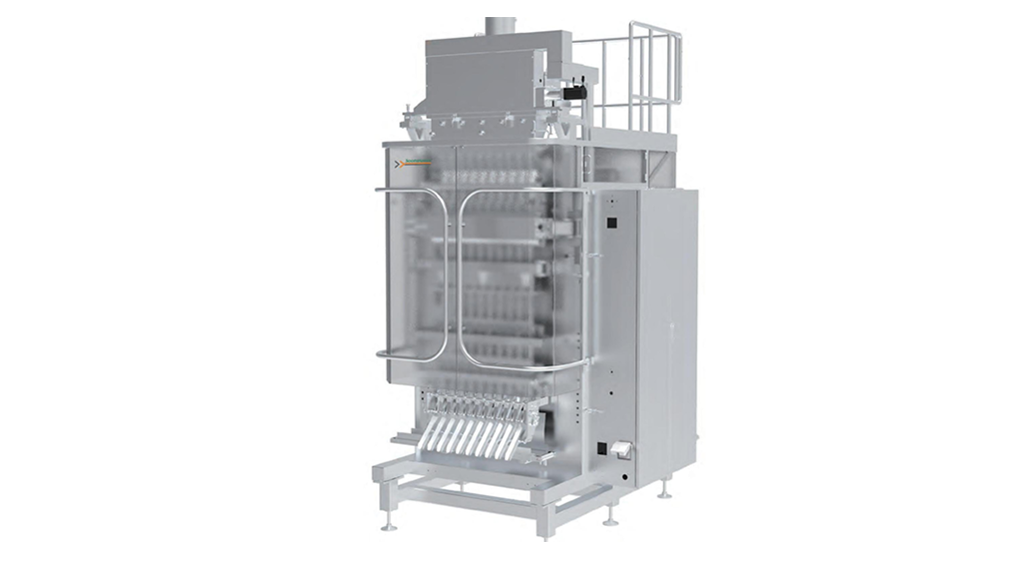
Vertical Packing
Vertical sealing servo, heat sealing servo
cold sealing servo, cutter servo
DKXL-650
Precision weighing or multi-head scales ensure consistent bag weight, with quality sensors enhancing packaging accuracy.
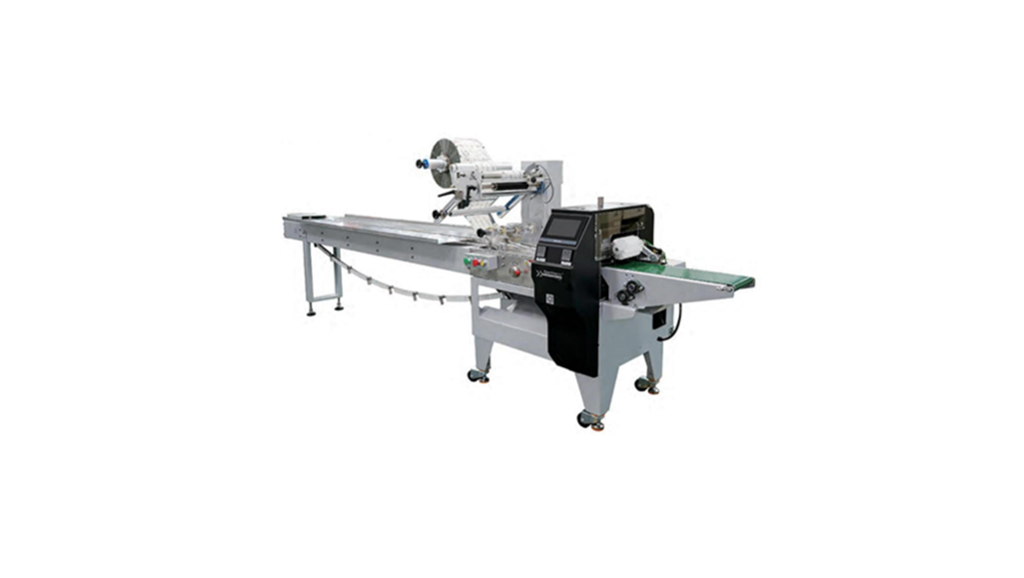
WP20
Automatically complete the processes of bag making, measuring, filling, sealing, bag cutting, etc., greatly improving the packaging speed.
How To Choose The Right Machine Type?
This video provides a demonstration of a fully automatic strapping tool:
“How to pack” actually depends to a large extent on your degree of automation. In actual factory applications, we usually look at these three mainstream programs:
Semi-Automatic Baler
Suitable for medium and low yield operations. The worker manually put the box on it and put the leader into the induction slot. Once the sensor “bites” the leader, the rest of the tightening, sealing and cutting are handed over to the machine. This kind of machine is extremely cost-effective, which is what we often call “an excellent entry-level choice”.
Fully Automatic Baler
This is designed for 24/7 high strength production lines. They are usually embedded directly in the conveyor belt and do not need to be guarded at all. The machine can automatically sense incoming materials and tie one or more tapes at preset intervals. In the kind of factory that pursues extreme throughput, this kind of machine is standard.
Handheld Packaging Tools
For those large items that cannot be moved to the table (such as pallets or large wooden boxes), hand-held tools are a lifesaver. It is equivalent to bringing the “machine” to the product. There are battery-driven (friction welding) and pneumatic ones. Although the size is small, the pulling force and sealing strength are not the same as large machines.
Author: Marcus Thompson
“As a packaging systems specialist with over a decade of experience in industrial automation, I have helped hundreds of businesses optimize their logistics lines. I’m passionate about breaking down complex machinery—like strapping systems—into simple, actionable insights to help you improve efficiency and secure your supply chain.”
Last updated: April 20, 2026