
 Soonqian
Packaging Machine Maintenance
Packaging machine maintenance is a strategic process that combines preventive care and daily operator routines to maximize equipment uptime and seal integrity. A strict maintenance strategy should focus on four core pillars:
- Daily Hygiene: Remove debris to prevent sensor errors and clean sealing jaws of product residue.
- Weekly Lubrication: Grease moving cross-seal bars, chains, and open gears to reduce friction.
- Monthly Inspection: Check pneumatic cylinders for leaks and replace high-wear consumables like Teflon tapes and cutting blades.
- Quarterly Calibration: Test and calibrate temperature and pressure sensors to ensure consistent packaging quality.
By shifting from reactive repairs to this proactive schedule, you extend the machinery’s lifespan and prevent costly production stoppages.
Daily Hygiene
The most effective step in packaging machine maintenance is actually started before the machine is turned on and is not completed until the shift is over. Many people think that daily cleaning is just to make the machine look cleaner; this is definitely a functional requirement, mainly to prevent mechanical interference and sensor “blinding.”
Remove Debris And Protect The Sensor
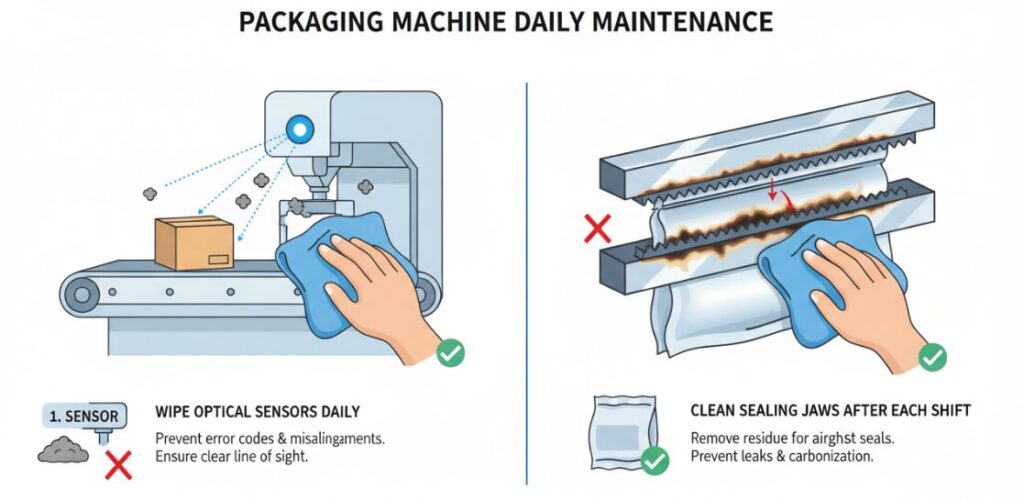
Accumulated dust, product debris, or film waste are often the culprits that cause frequent error codes. Photoelectric eye sensors require a clear line of sight to identify color marks and product locations. Once the dirt blocks these sensors, the machine will inexplicably stop, or the packaging film will deviate. Therefore, I always emphasize that all optical sensors should be wiped every day to ensure that the data received by the logic controller of the machine is accurate.
Cleaning Closure Jaws
The sealing jaw is the heart of the packaging process. After a shift, product residue or molten film can easily accumulate on the jaw surface. If no one attends to it, these residues will carbonize, forming a hard and uneven surface, causing the sealing jaw to fail to apply uniform pressure. Daily cleaning ensures that the surface of the sealing jaw is smooth, which is the key to achieving air-tight sealing, preventing leakage, and ensuring product freshness.
Weekly Lubrication
If daily cleaning is to protect the sensors and seals, the focus of weekly maintenance is to keep the mechanical parts alive. Friction is the mortal enemy of high-speed packaging equipment, which can lead to overheating and premature component scrap.
Grease The Moving Cross Seal Bar
The cross-seal bar performs thousands of cycles per day. If there is not enough lubrication, the direct contact between metal and metal will generate excessive heat, which will not only deform the cross-seal bar but even cause the bearing to lock directly. What we have to do is simple: apply food-grade lubricant to the guide rods and bearings every week. This ensures smooth operation and maintains a stable cycle speed.
Chain And Open Gear
The drive chain and open gear system are responsible for transmitting power to feed the film and product into the machine. If these parts are “dry ground,” they are easily elongated or tooth surface wear occurs. Establish a weekly lubrication schedule that can form a protective film between the contact points. You will find that this not only significantly reduces noise and vibration but also prevents the kind of catastrophic fracture failure of the drive system.
Monthly Inspection
A robust maintenance plan must take into account components that are designed to age over time. The monthly inspection is to allow the maintenance team to find out and replace these “vulnerable parts” before any trouble occurs in the production operation.
Check The Cylinder For Leaks
Many of today’s packaging machines rely on pneumatic cylinders to perform actions for a long time; the seal inside the cylinder will dry or crack, causing air leakage. These leaks will cause the system pressure to drop; the direct result is weak seals or slow machine action. Every month, you should listen for the hissing sound of air leakage and check the pressure gauge to ensure that the cylinder can maintain the required strength.
Replace High Wear Consumables
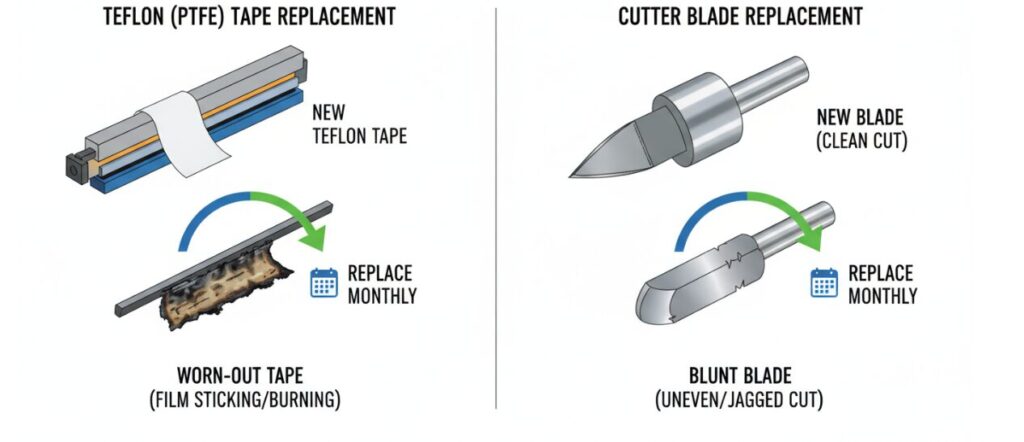
Parts like Teflon (PTFE) tape and cutters are consumables that have a fixed life.
- Teflon tape: They cover the heating element to prevent film sticking. Once the Teflon wears through, the film sticks to it and burns. Changing it once a month can avoid this carbon deposit problem.
- Cutter: The cutting of the packaging bag cut by a blunt knife is uneven, which looks unprofessional and may even lead to continuous cutting and jamming. Replace the blade every month to ensure that each cut is crisp and neat.
Quarterly Calibration
The last line of defense for packaging machine maintenance is to ensure the accuracy of machine operation. Even well-lubricated and clean machines can drift through months of vibration and thermal cycling.
Temperature Sensor Calibration
The temperature displayed on the HMI (Human Machine Interface) must match the actual temperature of the closure block. Even a few degrees of deviation may lead to “cold sealing” or “hot sealing.” Calibrate with an external thermometer once a month to ensure that the heating element is working exactly according to the recipe.
Pressure Sensor Test
Sealing requires a specific combination of heat, time, and pressure. If the pressure sensor value drifts, the sealing jaws may not be able to clamp enough to fuse the film layers, regardless of the temperature. Validation and recalibration of these sensors ensure that the machine is applying precise force to ensure seal integrity, thereby maintaining the high quality of the final packaged product.
Author: Mark Thompson
I am a Senior Field Service Engineer with over 16 years of experience in the packaging industry. Having troubleshooted hundreds of sealing systems, I specialize in preventive packaging machine maintenance strategies. I hope to help operators shift from reactive repairs to proactive care, ensuring consistent seal integrity and extending equipment lifecycles through the practical routines outlined in this guide.
